[SLAM Study 4주차] 실제 rosbag Offline Deskew: UNIST Livox와 Go2 연결
SLAM 공부 4주차에 실제 rosbag에서 UNIST Livox gyro-integrated rotation deskew를 메인 시각화로 보고, Go2 LowState estimated SE(3) deskew를 연구 연결용 보조 근거로 정리한다.
0. 이번 주에 잡아야 하는 것
3주차에는 synthetic world에서 deskew 수식이 맞는지 확인했습니다.
1
2
3
4
clean cloud 생성
-> synthetic re-skew
-> exact trajectory로 deskew
-> clean cloud 복원 확인
4주차는 실제 rosbag으로 넘어갑니다.
처음에는 Go2 walking bag으로 LowState 기반 SE(3) deskew까지 연결했습니다. 연구 주제와는 잘 맞지만, 야외 scan이라 블로그 대표 그림으로는 구조가 선명하지 않았습니다.
그래서 새로 받은 UNIST Livox MCAP bag을 4주차 대표 시각화로 다시 돌렸습니다.
이번 글의 구성은 다음처럼 잡습니다.
1
2
3
4
5
6
7
8
9
UNIST Livox:
  메인 시각화
  point time + gyro-integrated rotation-only deskew
  scan geometry가 실제로 크게 바뀌는 예제

Go2 May 7 bag:
  연구 연결용 보조 근거
  로봇개 walking scan에서 cm-scale correction
  LowState contact-kinematic estimated SE(3) pipeline
즉 주연은 UNIST Livox이고, Go2는 연구적 의미를 잡아주는 조연입니다.
이렇게 해야 그림은 보기 좋게 가져가면서도, 전체 연구 주제인 quadruped gait-induced LiDAR motion과의 연결을 잃지 않습니다.
1. 4주차의 중심 질문
이번 주 질문은 다음입니다.
실제 rosbag에서 point time과 IMU를 이용해 한 scan을 deskew하면, point cloud geometry가 어떻게 달라지는가?
여기서 가장 중요한 구분은 correction과 error입니다.
1
2
3
4
5
deskew correction:
raw point와 deskewed point가 얼마나 달라졌는가

deskew error:
deskewed point가 정답 clean/reference point와 얼마나 다른가
실제 rosbag에는 3주차 synthetic 실험처럼 정답 clean cloud가 없습니다.
따라서 이번 글의 p95 displacement는 정확도 개선량이 아닙니다.
정확한 표현은 다음입니다.
1
2
3
p95 correction magnitude
deskew correction size
raw-to-deskewed displacement
틀린 표현은 다음입니다.
1
2
3
p95 error
accuracy improved by 0.636 m
ground-truth deskew result
2. Deskew 기본식은 그대로
4주차에서도 deskew 식은 같습니다.
\[{}^{L(t_r)}\mathbf{p}_i = \left({}^W T_L(t_r)\right)^{-1} {}^W T_L(t_i) {}^{L(t_i)}\mathbf{p}_i\]3주차와 다른 점은 ${}^W T_L(t_i)$를 synthetic trajectory에서 가져오지 않는다는 것입니다.
실제 rosbag에서는 trajectory를 다음 중 하나로 만들어야 합니다.
1
2
3
4
5
6
IMU gyro integration
IMU orientation interpolation
constant-velocity model
LIO 내부 trajectory
external odometry
LowState 기반 proprioceptive trajectory
UNIST bag에는 pose, odometry, LowState가 없었습니다. 그래서 이번 대표 시각화는 full SE(3)가 아니라 gyro-integrated rotation-only deskew입니다.
Go2 bag은 /lowstate가 있어서 estimated translation을 넣은 SE(3) code path까지 연결했습니다. 하지만 그 translation은 ground truth가 아니라 contact-kinematic estimate입니다.
3. UNIST Livox MCAP 데이터
대표 시각화에 사용한 bag은 다음입니다.
1
/home/iamjaehka13/unist_rosbag/6_24_204_2_0-001.mcap
사용 topic은 다음입니다.
1
2
LiDAR: /livox/lidar
IMU:   /livox/imu
LiDAR message type은 livox_ros_driver2/msg/CustomMsg입니다.
이 bag의 장점은 point time을 만들기 쉽다는 것입니다. Livox custom point에는 offset_time이 있고, message에는 timebase가 있습니다.
이번 데이터에서는 offset_time 단위가 nanoseconds였습니다.
따라서 point별 시각은 다음처럼 만듭니다.
\[t_i = \mathrm{timebase} + \mathrm{offset\_time}_i \times 10^{-9}\]이 구조 덕분에 각 point가 scan 안에서 언제 측정됐는지 직접 만들 수 있습니다.
4. IMU orientation 대신 gyro integration
UNIST bag의 /livox/imu에는 orientation quaternion field가 있었습니다.
하지만 전체 IMU message를 확인했을 때 orientation quaternion은 identity였습니다.
1
2
3
imu_orientation_all_identity: True
orientation_max_abs_xyz: 0.000e+00
orientation_max_abs_w_minus_1: 0.000e+00
따라서 orientation field를 그대로 쓰면 scan 내부 회전이 없는 것처럼 됩니다.
이번 구현에서는 /livox/imu의 angular_velocity를 scan window에서 적분해서 rotation trajectory를 만들었습니다.
1
2
3
4
5
trajectory_source:
/livox/imu angular_velocity integrated within bag

deskew_type:
rotation_only_gyro_integrated
translation은 보정하지 않았습니다.
1
translation_compensated: false
이 bag에는 pose/odometry topic이 없었기 때문입니다.
Gyro Integration이 실제로 하는 일
IMU gyro는 angular velocity를 줍니다.
\[\boldsymbol{\omega}(t) = \begin{bmatrix} \omega_x(t) \\ \omega_y(t) \\ \omega_z(t) \end{bmatrix}\]짧은 시간 $\Delta t$ 동안 회전은 작은 rotation vector로 근사할 수 있습니다.
\[\Delta \boldsymbol{\theta} \approx \boldsymbol{\omega}(t)\Delta t\]이를 SO(3) exponential로 회전에 누적하면:
\[R_{k+1} = R_k \exp \left( [\boldsymbol{\omega}_k \Delta t]_\times \right)\]입니다.
이번 UNIST deskew는 이 과정을 scan window 안에서 수행한 것입니다.
1
2
3
4
/livox/imu angular_velocity
-> scan 시간 구간에서 적분
-> point time마다 orientation interpolation
-> rotation-only deskew
여기서 중요한 제한이 있습니다.
gyro integration은 orientation 변화량을 만들 수 있지만, translation은 만들지 못합니다.
또한 gyro bias가 있으면 시간이 길어질수록 orientation drift가 누적됩니다.
이번 scan은 약 0.1 s로 짧기 때문에 rotation-only 시각화에는 쓸 수 있지만, 이것을 긴 구간의 reference trajectory라고 부르면 안 됩니다.
Rotation-only Deskew의 한계
rotation-only deskew는 다음을 가정하는 것과 비슷합니다.
1
2
scan 동안 LiDAR 원점 translation은 무시할 수 있다.
하지만 LiDAR orientation 변화는 보정한다.
이 가정은 회전이 dominant한 장면에서는 꽤 큰 geometry 변화를 보여줄 수 있습니다.
하지만 실제 rigid body motion은 SE(3)입니다.
1
pose(t) = rotation(t) + translation(t)
translation이 큰 구간에서는 rotation-only 결과가 오히려 일부 metric에서 애매하게 보일 수 있습니다.
그래서 UNIST 결과는 “rotation deskew가 point geometry를 크게 바꾼다”는 시각화에는 좋지만, full SE(3) deskew 검증으로 쓰면 안 됩니다.
5. 새 Livox MCAP explorer
UNIST MCAP용으로 새 스크립트를 추가했습니다.
1
study/livox_mcap_deskew_explorer.py
이 스크립트가 하는 일은 다음입니다.
1
2
3
4
5
6
7
1. /livox/lidar CustomMsg를 읽는다.
2. timebase + offset_time으로 point time을 만든다.
3. /livox/imu angular_velocity를 읽는다.
4. scan window에서 gyro를 적분해 rotation trajectory를 만든다.
5. raw cloud와 gyro-deskewed cloud를 저장한다.
6. correction magnitude와 ground plane RMS를 계산한다.
7. 보기 좋은 후보 scan을 ranking한다.
이번 대표 후보는 rank 1입니다.
1
2
3
4
5
6
study/results/offline_deskew/unist_livox/rank_01_scan_001896/
  comparison.png
  metrics.json
  raw_time_color.ply
  gyro_integrated_time_color.ply
  gyro_integrated_displacement_color.ply
6. UNIST 대표 결과
대표 이미지는 scan_id=1896입니다.
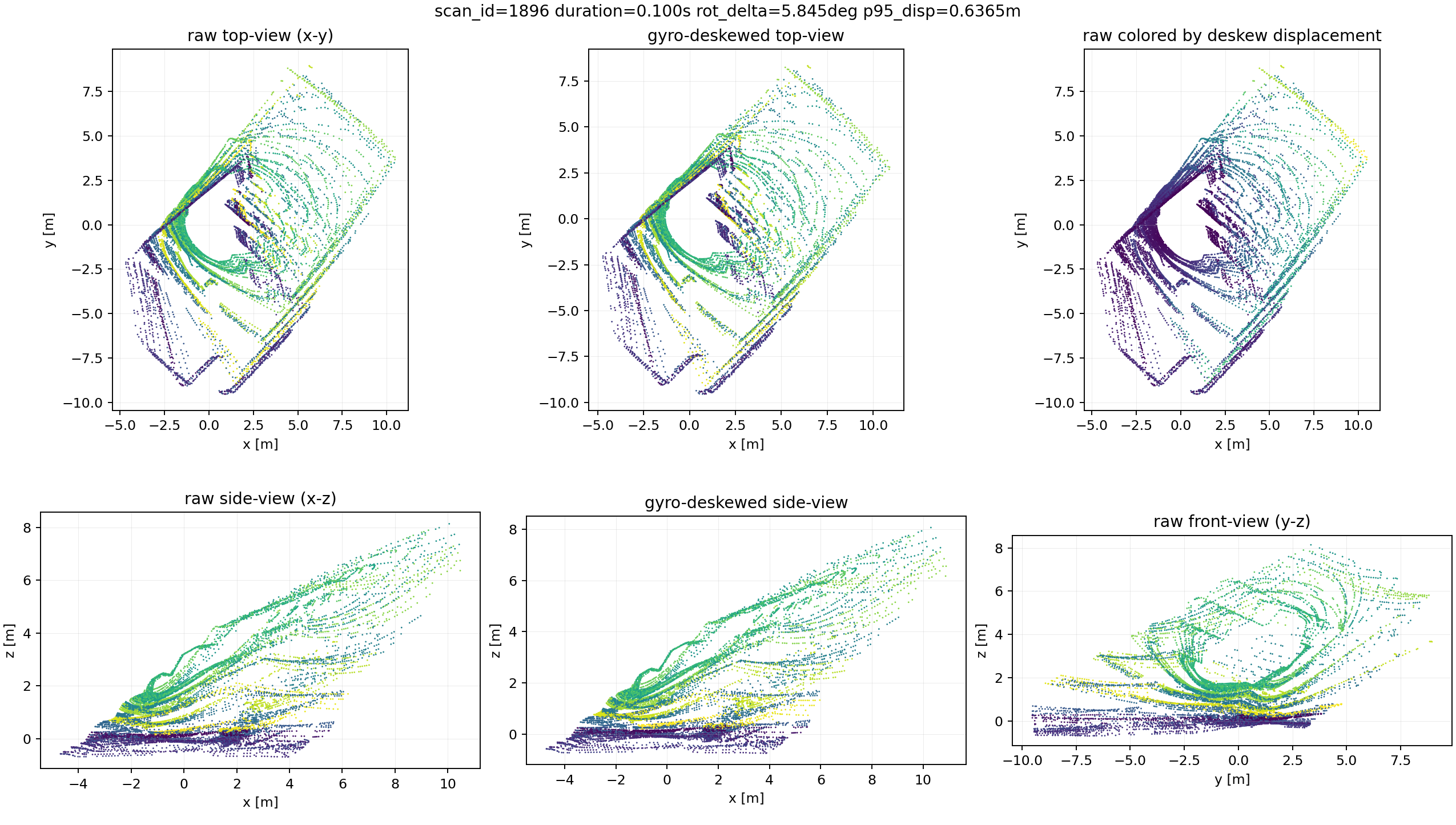
그림은 다음을 보여줍니다.
1
2
3
4
5
6
top-left: raw top-view
top-middle: gyro-deskewed top-view
top-right: raw cloud colored by deskew displacement
bottom-left: raw side-view
bottom-middle: gyro-deskewed side-view
bottom-right: raw front-view
UNIST 결과의 핵심 수치는 다음입니다.
| 항목 | 값 |
|---|---|
scan_id | 1896 |
| point count | 19624 |
| scan duration | 0.100312 s |
| IMU samples in scan | 20 |
| gyro-integrated rotation delta | 5.845298 deg |
| gyro p95 | 1.068314 rad/s |
| p95 correction | 0.636469 m |
| max correction | 1.109851 m |
| timestamp clip count | 0 |
| raw ground RMS | 0.246322 m |
| gyro-deskewed ground RMS | 0.245906 m |
이 scan은 블로그 대표 예제로 좋습니다.
이유는 세 가지입니다.
1
2
3
1. point 수가 충분히 많다.
2. 구조물이 Go2 outdoor scan보다 훨씬 선명하다.
3. rotation-only deskew correction이 크게 보인다.
7. UNIST 결과 해석
이번 UNIST scan은 약 100 ms 길이입니다.
그 scan 안에서 gyro-integrated rotation delta는 약 5.85 deg였습니다.
그래서 rotation-only deskew correction의 p95가 약 0.636 m까지 나왔습니다.
이 값은 꽤 큽니다. 하지만 다시 말하면 이것은 error가 아니라 correction magnitude입니다.
정확한 해석은 다음입니다.
1
2
한 scan 안에서 rotation trajectory를 반영하면,
raw point 위치가 p95 기준 약 0.64 m 정도 이동한다.
틀린 해석은 다음입니다.
1
deskew로 0.64 m 정확도가 좋아졌다.
ground RMS도 조심해서 봐야 합니다.
| Metric | Raw | Gyro-deskewed | Difference |
|---|---|---|---|
| ground RMS | 0.246322 m | 0.245906 m | 0.000416 m lower |
수치상으로는 아주 조금 낮아졌지만, 차이는 약 0.4 mm입니다.
따라서 이번 결과를 정량 성능 개선으로 주장하면 안 됩니다.
이번 UNIST 결과의 역할은 이것입니다.
1
2
실제 Livox scan에서 point time과 gyro integration만으로도
rotation deskew가 point geometry를 크게 바꾸는 것을 보여주는 시각화 예제
8. 왜 Go2 결과를 버리면 안 되는가
UNIST 결과는 예쁘고 deskew 효과가 잘 보입니다.
하지만 이것만 쓰면 4주차 글은 일반 Livox deskew 예제가 됩니다.
내 연구 주제는 단순한 일반 LiDAR deskew가 아니라, 로봇개 보행에서 생기는 body motion이 LiDAR SLAM에 어떤 영향을 주는지 보는 것입니다.
그래서 Go2 결과는 조연으로 필요합니다.
Go2 결과의 역할은 다음입니다.
1
2
3
1. 로봇개 walking scan에서도 cm-scale correction이 생긴다.
2. /lowstate를 이용해 estimated translation을 넣는 SE(3) code path를 열었다.
3. 따라서 이 연구가 quadruped gait-induced LiDAR motion 문제와 연결된다.
다만 Go2 결과를 메인 그림으로 쓰기에는 약했습니다.
1
2
3
outdoor scan이라 구조가 덜 선명함
point 수가 UNIST scan보다 적음
SE(3) translation이 ground truth가 아니라 estimated term
따라서 역할 분리가 맞습니다.
1
2
UNIST: 메인 시각화
Go2: 연구 연결
9. Go2 LowState SE(3) 보조 결과
Go2 결과는 이전에 만든 다음 scan입니다.
1
2
3
bag: may07_bag1_walk_clean
scan_id: 14327
segment: walk_like
새로 만든 스크립트는 다음입니다.
1
study/go2_lowstate_leg_odometry.py
이 스크립트는 /lowstate에서 다음 정보를 읽습니다.
1
2
3
4
5
관절각 q
관절속도 qdot
foot_force
IMU gyro
Go2 URDF
핵심은 역기구학만으로 base pose를 직접 뽑는 것이 아닙니다.
stance foot이 짧은 순간 world에서 고정되어 있다고 보고, FK + Jacobian + contact constraint로 body velocity를 추정했습니다.
사용한 식은 다음입니다.
\[\mathbf{v}_B \approx - \left( J(\mathbf{q})\dot{\mathbf{q}} + \boldsymbol{\omega}_B \times \mathbf{p}_{BF} \right)\]이 식은 다음 contact constraint에서 나온 직관입니다.
stance foot이 순간적으로 world에서 고정되어 있다고 보면, foot의 world velocity는 0에 가깝습니다.
1
stance foot world velocity ~= 0
base frame에서 foot 위치를 $\mathbf{p}_{BF}$라고 하면, foot velocity에는 세 항이 섞입니다.
1
2
3
base translation velocity
base angular velocity 때문에 생기는 lever-arm velocity
joint motion 때문에 foot이 움직이는 velocity
이를 base frame에서 쓰면 대략:
\[\mathbf{v}_{F} \approx \mathbf{v}_{B} + \boldsymbol{\omega}_{B} \times \mathbf{p}_{BF} + J(\mathbf{q})\dot{\mathbf{q}}\]stance foot이 고정되어 있으니 $\mathbf{v}_F \approx 0$으로 두고 정리하면:
\[\mathbf{v}_B \approx - \left( J(\mathbf{q})\dot{\mathbf{q}} + \boldsymbol{\omega}_{B} \times \mathbf{p}_{BF} \right)\]가 됩니다.
즉 이것은 “관절각으로 base pose를 직접 푼 것”이 아닙니다.
짧은 순간의 contact constraint를 이용해 body translation velocity를 추정한 것입니다.
그래서 이름도 measured odometry가 아니라 contact-kinematic estimated translation에 가깝습니다.
왜 Foot Slip이 핵심 리스크인가
위 식은 stance foot이 world에서 고정되어 있다는 가정에 기대고 있습니다.
하지만 실제 보행에서는 다음 일이 생길 수 있습니다.
1
2
3
4
5
foot slip
soft ground
contact timing error
foot force threshold error
URDF / joint calibration error
이 경우 $\mathbf{v}_F \approx 0$ 가정이 깨집니다.
그러면 추정된 $\mathbf{v}_B$도 bias를 갖습니다.
그래서 LowState SE(3) deskew는 연구적으로 흥미로운 proprioceptive path이지만, 외부 odometry나 SLAM trajectory와 비교하기 전까지는 reference trajectory가 아닙니다.
이 translation estimate를 기존 offline_deskew_explorer.py에 넣기 위해 다음 option도 추가했습니다.
1
2
3
--scan-id
--timestamp-source
--trajectory-translation-kind estimated
Go2 결과의 주요 수치는 다음입니다.
| 항목 | 값 |
|---|---|
scan_id | 14327 |
| point count | 1397 |
| scan duration | 0.069274 s |
| IMU samples in scan | 17 |
| orientation delta | 3.203842 deg |
| LowState samples in scan window | 34 |
| LowState estimated translation delta | 0.015085 m |
| rotation-only p95 correction | 0.064710 m |
| LowState estimated SE(3) p95 correction | 0.072625 m |
| SE(3) vs rotation-only p95 difference | 0.015644 m |
이 결과에서 말할 수 있는 것은 다음입니다.
1
2
3
Go2 walking scan에서도 rotation-only correction이 cm-scale로 생긴다.
LowState estimated translation을 넣으면 SE(3) correction이 조금 더 커진다.
translation term은 0이 아니다.
하지만 이렇게 쓰면 안 됩니다.
1
2
3
LowState SE(3) deskew가 정답이다.
Go2 odometry가 검증됐다.
SLAM 성능이 좋아졌다는 증거다.
정확한 이름은 다음입니다.
1
LowState contact-kinematic estimated-translation SE(3) deskew
짧게는 다음처럼 쓸 수 있습니다.
1
2
LowState estimated SE(3) deskew
proprioceptive SE(3) deskew
10. Go2 시간축 문제
Go2 결과에서 중요한 문제는 시간축이었습니다.
LiDAR cloud와 IMU는 header time을 씁니다.
하지만 /lowstate에는 header stamp가 없습니다. 그래서 LowState는 rosbag2 storage time으로 읽었습니다.
그대로 섞으면 두 trajectory가 서로 다른 시간축에 놓입니다.
이번 Go2 bag에서는 다음 offset을 적용했습니다.
1
header_timestamp - bag_timestamp = -995.347479105 s
즉 LowState bag timestamp에 이 offset을 더해서 LiDAR header time 축에 맞췄습니다.
1
2
lowstate_output_time =
lowstate_bag_timestamp + (-995.347479105)
이 alignment를 하지 않으면 LiDAR scan window와 LowState trajectory window가 서로 다른 구간을 가리키게 됩니다.
그 상태에서 SE(3) deskew를 하면 결과가 틀어질 수밖에 없습니다.
11. Claim Boundary
이번 4주차 글의 claim은 다음 정도로 제한해야 합니다.
1
2
3
4
5
6
7
UNIST Livox MCAP:
point time과 gyro integration으로 rotation-only deskew를 수행했고,
선택 scan에서 p95 0.636 m 수준의 correction이 생겼다.

Go2 May 7 walking scan:
rotation-only correction이 cm-scale로 생겼고,
LowState contact-kinematic odometry로 estimated translation SE(3) path를 열었다.
아직 말하면 안 되는 것은 다음입니다.
1
2
3
4
5
ground-truth deskew를 했다.
reference trajectory를 얻었다.
SLAM 성능이 개선됐다.
Go2 LowState odometry가 외부 기준으로 검증됐다.
UNIST 결과로 로봇개 보행 claim을 증명했다.
UNIST는 시각화용 실제 Livox deskew 예제입니다.
Go2는 로봇개 연구 연결용 보조 근거입니다.
둘을 섞어서 하나의 강한 claim으로 만들면 안 됩니다.
12. 남은 리스크
UNIST 쪽 리스크는 다음입니다.
| 리스크 | 의미 |
|---|---|
| no pose/odom | translation 포함 SE(3) deskew는 이 bag으로 불가 |
| gyro integration drift | 짧은 scan window에서는 쓸 수 있지만 reference trajectory는 아님 |
| orientation quaternion identity | IMU orientation field를 그대로 쓸 수 없음 |
| ground RMS 약함 | ground RMS 차이가 매우 작아서 성능 개선 claim으로 쓰기 어려움 |
| correction vs error | p95 displacement는 error가 아니라 correction magnitude |
Go2 쪽 리스크는 다음입니다.
| 리스크 | 의미 |
|---|---|
| foot slip | stance foot 고정 가정이 깨질 수 있음 |
| raw foot force 신뢰도 | Unitree foot force는 calibrated Newton이 아니라 raw contact proxy |
| base-to-LiDAR extrinsic | LowState trajectory 생성 summary에는 base-to-LiDAR translation이 ignored 된 가정이 있음 |
| external odometry 없음 | LowState estimate가 실제 body translation과 얼마나 맞는지 아직 검증하지 않음 |
| surface metric 약함 | outdoor scan에서는 plane metric이 품질 판단에 약할 수 있음 |
따라서 이번 결과는 구현과 시각화 단계입니다.
정량 연구 결과로 쓰려면 다음이 필요합니다.
1
2
3
4
5
external odometry
SLAM trajectory 비교
반복 scan 통계
wall thickness / plane residual이 의미 있는 실내 구간
scan-to-map residual 또는 odometry drift와의 연결
13. 다음 단계
다음 단계는 두 갈래입니다.
첫째, UNIST처럼 구조가 선명한 bag에서 surface consistency metric을 더 잘 잡습니다.
1
2
3
4
wall thickness
plane residual
normal dispersion
scan-to-map residual
둘째, Go2 쪽에서는 LowState trajectory를 검증해야 합니다.
1
2
3
4
LowState odometry vs external odometry
LowState odometry vs SLAM trajectory
LowState contact estimate vs foot slip condition
validated trajectory 기반 SE(3) deskew
이 두 가지가 연결되면 다음 claim으로 갈 수 있습니다.
1
2
3
4
5
quadruped gait-induced body motion
-> scan 내부 LiDAR pose 변화
-> deskew correction / residual distortion
-> scan matching residual 증가
-> map blur 또는 odometry drift
14. 이번 주 정리
4주차를 한 문장으로 정리하면 다음입니다.
실제 rosbag에서 point time과 IMU를 이용해 offline deskew를 수행했고, UNIST Livox는 시각화 예제로, Go2 LowState는 로봇개 연구 연결용 보조 근거로 정리했다.
이번 주 흐름은 다음입니다.
1
2
3
4
5
6
7
3주차 synthetic deskew 수식 확인
-> UNIST Livox MCAP에서 point time 추출
-> /livox/imu gyro integration으로 rotation trajectory 생성
-> raw vs gyro-deskewed cloud 시각화
-> p95 correction은 error가 아니라 보정량으로 해석
-> Go2 walking scan의 cm-scale correction으로 연구 연결
-> LowState estimated SE(3)는 아직 reference/GT가 아님을 명확히 둠
결론은 보수적으로 잡습니다.
1
2
3
UNIST는 메인 그림으로 좋다.
Go2는 연구 맥락상 필요하다.
둘을 섞어 강한 성능 claim으로 쓰면 안 된다.
이 구성이 4주차 블로그에는 가장 안전합니다.